
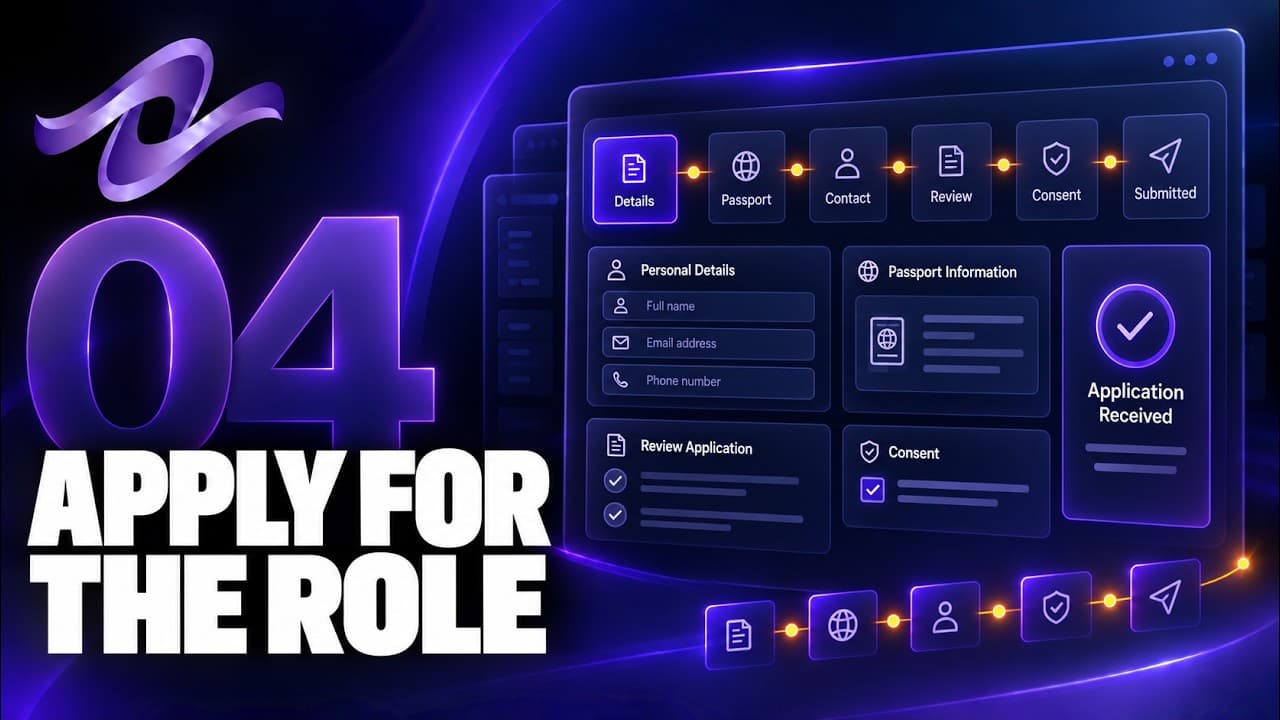
 Chapter 4
Hosted on YouTube. Nothing loads from YouTube until you press play.
Essentials · Chapter 4 · 4 of 24 in the series
Apply for a Job in Quelixa
See the hiring process from the candidate's side. Sophia discovers the Product Designer role, completes Quelixa's six-step application and follows her progress through a passwordless candidate portal.
01Lesson notes
What you will learn#
- How the six-step application checks information along the way
- How international ID and contact details are handled in this example
- How a candidate reviews the full form before submitting
- How submission creates an application number and tracking page
Step by step#
Careers › Product Designer
- Apply now — About ten minutes, and no account needed.
- The terms — Pay, occupation, degree and experience — and that applying is free.
- Selection process — Every step she will go through, before she starts.
- How well do I fit? — A fit check against her profile, from the Intelligence series.
Careers › Apply › Who you are
- Fill from my CV — Aurora drafts the form from a CV — covered in the Intelligence series.
- National ID or passport — The identity fields follow the company's country settings.
Careers › Apply › Who you are
- Please fix the following — The required fields, named, before she can move on.
Careers › Apply › Who you are
- National ID or passport number — Stored exactly as she types it.
- Mobile — With the country code — the hint follows the company's country.
Careers › Apply › Skills
- Skills — She picks from the job's own list, or types her own.
Careers › Apply › Address & contacts
- Salary, notice and availability — The three answers an offer depends on.
Careers › Apply › Education
- Qualification — Level with its international code, and the grade as her country gives it.
Careers › Apply › Experience
- Current role — A start date and a tick: she works here now.
- Previous role — Dates in and out.
Careers › Apply › Documents
- Curriculum Vitae — Attached here, kept on her profile, reused next time.
Careers › Apply › Review & submit
- What she is about to send — Identity, education, experience and documents, side by side.
Careers › Apply › Review & submit
- How we use your data — Who holds it, what for, for how long — and her consent.
- Applying is free — No recruitment fee, at any stage.
Candidate portal › Application received
- Application received — Her number, and the email it was confirmed to.
Candidate portal › Dashboard
- Your applications — Seven steps; the first one lit.
- Latest updates — Everything that happens to it, dated.
Open your careers page as a candidate would and apply to a test position with a practice profile. Leave a required field empty on the first step to see where the form stops you, then complete it and open the portal from the confirmation email.
Transcript
Twenty minutes, it says
Lina: Tuesday evening in Stockholm. Sofia has read the Singapore advert twice, and she has a question most candidates have.
Sofia Lindqvist: Twenty minutes, it says. Every form says twenty minutes.
David: And then it asks for the same CV three times, in three different boxes.
Lina: Which is where good people give up. So this chapter crosses to the other side of the screen, and fills the form in the way she does.
Lina: This is chapter four. A candidate finds the role, applies in six steps, and follows her application from her own portal — without an account, a password, or a phone call.
Everything before the button
Lina: This is the job page she arrives on. One button matters, and it says what it will cost her: about ten minutes, and no account.
Lina: Above it, the terms. The monthly pay, the occupation, the degree and the years the post asks for. And a line that should be on every advert: applying is free, at every stage.
David: She knows the rules before she types a single word.
Lina: And the steps. Scrutiny, a written test, an interview, a merit list, an offer — the whole road is on the page before she starts.
David: Most adverts stop at the job description.
Lina: Most do. This one tells her how she will be judged.
Lina: The fit check underneath compares her profile with the role. That belongs to the Intelligence series, so today she goes straight for the button.
What a good application form does
David: So what makes people actually finish a form like this?
Lina: Three things.
Lina: It asks only what the decision needs. Every field here is used by a later step — scrutiny, the test, the offer. Nothing is collected just in case.
Lina: It checks as it goes. If something is missing, she hears about it on the step it belongs to, not after twenty minutes of typing.
Lina: And it shows her everything before it sends. One review page, the whole application, and a clear question about her data.
Six steps, one at a time
Lina: Six steps across the top, and the first is who she is.
Lina: There is a shortcut in the corner that drafts the whole form from a CV. It is an Aurora feature, and we come back to it in Intelligence.
Lina: Notice the identity field. It asks for a national ID or passport number, because Northwind's settings say it hires internationally.
Caught on the step
Lina: Press continue on an empty page and it tells her, in plain words, what it still needs.
Lina: Name, email, mobile and date of birth. Four things, on the step where they belong.
David: Rather than a red page after the last step.
Lina: Exactly. The mistake is fixed where it was made.
Who she is
David: Filled in, that did not take long.
Lina: It never does, when it only asks what it needs.
Lina: Her passport number goes in as she types it. There is no thirteen-digit rule to fight with, because none applies here.
Lina: Her mobile carries its country code. Northwind talks to people in five countries, so a local format would help nobody.
Skills against the job
Lina: Further down, her skills. The job's own list is offered first, so she picks the three she has.
David: Does that matter later?
Lina: It does. Every skill she shares with the post raises her match, and the recruiter sees that match on her application.
Where, and when she could start
Lina: Step two is where she lives and how to reach someone in an emergency.
Lina: And three answers an offer depends on later: what she expects to earn, her notice period, and the first day she could start.
David: Salary before anyone has even met her?
Lina: What she expects, not what she will get. It saves an awkward conversation at the offer stage.
Lina: She puts the fourth of January as her first free day. Hold on to that date — it comes back in the last chapter.
Qualifications, in her system
Lina: Education. The level carries its international code.
David: So a master's from Stockholm and one from Singapore count the same?
Lina: They land on the same rung. That is what the code is for.
Lina: And she gives her grade the way her country does: pass with distinction. Nobody forces a percentage onto a system that does not use one.
The years add themselves
Lina: Experience, most recent first.
Lina: Her current role has a start date and a tick that says she still works there.
Lina: Her previous role has both dates.
David: And she never types a total?
Lina: Never. The years are counted from the dates, which is the number scrutiny will measure against the post's four-year minimum.
Documents, once
David: Which documents does she have to give?
Lina: The ones marked as required. The rest are optional.
Lina: She attaches her CV, her passport, her degree and a photograph. They stay on her profile, so the next application reuses them instead of asking again.
David: So the second application is quicker than the first.
Lina: Much quicker. The profile remembers; she only confirms.
The whole application, on one page
Lina: And the review page. Everything she entered, on one screen, before anything is sent.
David: Including the certificate she did not have?
Lina: Marked plainly: not provided. Nothing is hidden from her own review.
Her data, in plain words
Lina: Underneath, two things a candidate in any country is entitled to know.
Lina: That applying costs nothing, now or later. International fair-recruitment practice says a candidate never pays to be hired.
Lina: And how her data is used: who holds it, what for, and how long it is kept. She ticks her consent, then the declaration that it is all true.
David: Could she take it all back later?
Lina: Download it or delete it, herself, from the portal. That is written right there.
Received
Lina: She submits. Seven forty-four in the evening, and it is done.
Lina: An application number, and a confirmation to her email. That email also carries her way back in — a link, not a password.
David: How long did it take her, in the end?
Lina: Under the twenty minutes it promised. The next one will take five.
Her own portal
Lina: And this is her portal. It exists because she applied — nobody set it up for her.
Lina: Her application, with the seven steps of the process and the first one lit.
Lina: And a feed of what happens to it, each entry dated. Today it has one line: received.
David: So nobody has to chase anyone for news.
Lina: Nobody. When the process moves, this moves.
One application, followed
Lina: Open the application itself and she sees the same road in detail, a way to message the recruitment team, and her skill match for the role.
David: And if she changes her mind?
Lina: She withdraws, herself, at any time. Nobody has to be asked.
Chapter four, in five lines
Lina: Five lines.
Lina: The job page shows the terms and the whole road before she types a word.
Lina: Six short steps, each checked where it belongs.
David: And the ID field?
Lina: Follows the company's country, so an international hire is not squeezed into one nation's format.
Lina: One page to review, a promise that it is free, and consent in plain words.
Lina: And a portal of her own the moment she presses submit.
Ten on the board
Lina: By Thursday morning, Sofia is one of ten.
Mei Tan: Ten for one seat. Where do we start?
Elena Novak: With the rules we published. And without looking at a single name.
Lina: Which is chapter five.
Lina: Next time, the ten applications meet the rules — under a review that cannot see who anybody is. See you in chapter five.