
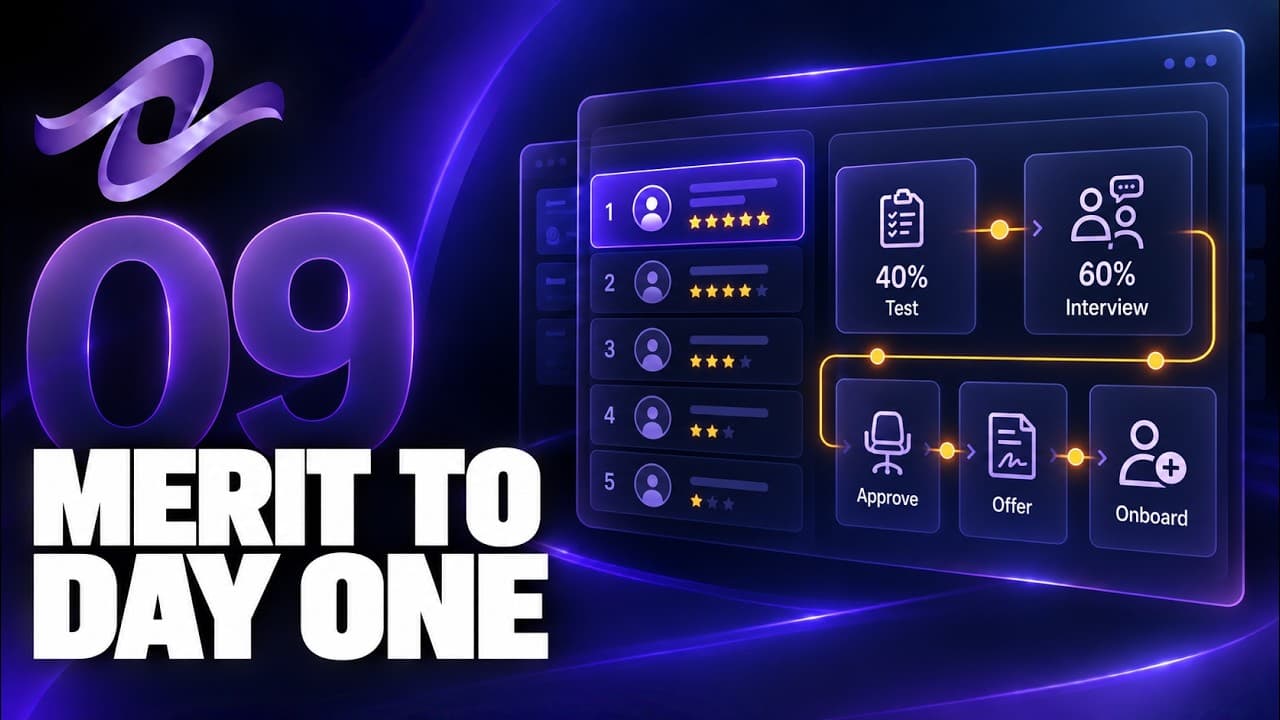
 Chapter 9
Hosted on YouTube. Nothing loads from YouTube until you press play.
Essentials · Chapter 9 · 9 of 24 in the series
Merit List to Job Offer & Onboarding in Quelixa
Finish the Recruitment Essentials journey: combine test and interview marks, release a ranked merit list, send the top candidate an offer, and turn an accepted application into an employee record.
01Lesson notes
What you will learn#
- How published weights explain the final ranking
- Why merit-list release is a separate human approval
- How the candidate responds to an offer through the portal
- How an accepted hire leads into employee and joining records
Step by step#
Recruitment › Job Posts › Merit list
- Test, interview, merit — Both marks shown, and the weighted score they produce.
Recruitment › Job Posts › Selection chair
- Waiting on a person — The list is ranked, and the offers are locked until the chair releases it.
Recruitment › Job Posts › Released
- Released by a person — The approval carries a name, a time and a sentence of reasoning.
Candidate portal › Dashboard
- The next step — Respond to the offer, with the date it has to be answered by.
Candidate portal › Application › Offer
- Accept & sign — Or decline, with a note.
Candidate portal › Accept and sign
- Signed, not clicked — Her typed name, the time, her network address and a fingerprint of the terms.
Recruitment › Applications › Sofia Lindqvist
- What happens next — Signed — and one action left: hire.
- The record of it — Every stage dated, both marks, the rank and the offer.
Recruitment › Applications › Hire
- What hiring actually does — Creates the employee from her resume and seats her on the reserved post.
Recruitment › Applications › Hired
- Every step, ticked — From New to Hired, with nothing skipped.
- Her record, complete — The marks, the rank and the offer that led here.
- What comes next — The joining record, already open.
Employees › Sofia Lindqvist
- Starts on 5 January — A new hire, with her start date — not a date she already joined.
- Tenure — Starts in two months.
Employee Requests › Onboarding › Sofia Lindqvist
- Joining — Start date, probation, pay, who she reports to, her work email.
- Where it stands — Hired, joining in progress, then on board.
- Who and where — Employee number, department and company.
On a job post's merit list, read both marks for the top two rows and the weights that produced the order. Find the control that releases the list and note who it is waiting on.
Transcript
Who is first?
Lina: Monday the twenty-sixth. Seven candidates, two marks each, one seat.
Mei Tan: I know who I would pick. Does that count?
Elena Novak: Your marks count — sixty per cent of the result. Your preference does not.
David: The list decides the order. People decide yes or no.
Lina: Exactly that. And in this chapter the order becomes an offer, and the offer becomes an employee.
Lina: This is the last chapter of Essentials. The two marks become a merit list, the chair releases it, the offer goes out by rank, and the application becomes an employee with a start date.
The list, and why it is in this order
Lina: And this is the merit list.
Lina: Every row shows both marks and the score they produce. Nothing is hidden behind the ranking.
Lina: Look at the top two. Claire scored eighty-five on the written paper — the highest of anyone. Sofia scored eighty.
David: And Sofia is first.
Lina: Because the interview carries sixty per cent and the test forty, and Sofia took the interview eighty-eight to seventy-eight. That weighting was published on the advert in chapter three, before a single person applied.
David: So the order can be explained to the person who came second.
Lina: Line by line.
Lina: And third on that list is Emma Ross — the candidate who only got this far because a manager waived the degree rule in writing. She is now ahead of four people who never needed a waiver.
Nobody offers anything yet
Lina: And then the process does something I think is its best single idea.
Lina: It stops. The list is ranked, the scores are in, and nothing can be offered to anybody.
David: Because the chair has not released it.
Lina: Because the chair has not released it. And the screen says so by name — it is waiting on Kenji Sato, and Send Offers by Rank is greyed out until he acts.
Lina: He can release it, or send it back. What he cannot do is let offers leak out while the ranking is still being argued about.
Signed, with a reason
Lina: He releases it, and the record closes the loop.
Lina: Approved by Kenji Sato, at a time, with the reason he gave.
David: Not approved by the system.
Lina: Never by the system. Every decision in this course has a person's name against it, and this is the last one before an offer exists.
Three things about this ranking
Lina: Three things make a merit list worth the name.
Lina: The weights were public before anyone applied. Sixty for the interview, forty for the test, on the advert.
Lina: Both marks are shown, so anyone can see why one person is above another.
David: And it cannot be nudged.
Lina: Not quietly. Regenerating it is an action on the record, and releasing it needs the chair. There is no version of this where somebody reorders the list on a Friday afternoon.
An offer, on her dashboard
Lina: Tuesday morning. Elena sends offers by rank — which, with one seat, means one offer, to the person at the top.
Lina: And this is Sofia's dashboard an hour later. The first card is the one thing she needs to do: answer the offer, by a date.
David: She could see every stage as it happened?
Lina: Every one — the test being ready, the result, the interview, the merit list, the offer. Nobody had to email her to say where she stood.
Read, then sign
Lina: She opens it: the pay, when it was sent, and the date she has to answer by — with a box for a note to the team.
Lina: Two ways out of this page: accept and sign, or decline. Either way the answer lands on the same record Elena is looking at.
A signature that holds up
Lina: She accepts by signing.
Lina: She types her name exactly as it is on her profile, and ticks to agree to sign electronically.
David: Is that actually binding?
Lina: It is a simple electronic signature under the rules most markets recognise — the American ESIGN Act and the European eIDAS regulation. What makes it hold up is what gets recorded: her name, the time, her network address, and a fingerprint of the exact terms she accepted.
Lina: Change a single word of the offer afterwards, and the fingerprint no longer matches.
The whole application, on one page
Lina: Here is the same moment on Elena's screen.
Lina: Every stage Sofia passed through, with its date. The test at eighty, the interview at eighty-eight, first on merit. And the offer: sent, answered, signed.
David: So the offer is not a letter somebody wrote. It is the next row on the same record.
Lina: The same record, from her first click on the careers page to this.
Lina: And on the right, the signature with its fingerprint — and one action left.
From candidate to employee
Lina: Hire. And read what it says it will do.
Lina: It creates the employee from her resume snapshot, and seats her on the post the requisition reserved — in chapter two.
David: So the seat Kenji approved in chapter two is the seat she sits in now.
Lina: The very same seat. The joining date is the fifth of January — the start date Mei wrote on the requisition, the day after the date Sofia gave as her first free one.
The last tick
David: And the strip is complete.
Lina: Every step.
Lina: New, scrutiny, test, interview, merit, offer, hired. Every step, in order, each one dated.
David: And the other six on the merit list?
Lina: Stay where they are, ranked, and told honestly. If the seat opens again, the list is still there.
Lina: On the right, the next record is already open: her joining.
An employee before day one
Lina: And she is an employee — two months before her first day.
Lina: Her record says so plainly: a new hire, starting on the fifth of January.
Lina: And her tenure does not pretend she has already joined. It says she starts in two months.
David: And her ID is the passport number she typed in October.
Lina: The same one, carried across — in the format the company's settings ask for.
The joining record
Lina: And the hire opens one more record, on the HR side: the joining.
Lina: Her employee number, her department, the company.
Lina: The fifth of January. Three months' probation. The pay from the offer. She reports to Kenji Sato, and her work email is already there.
David: So on day one, nobody is setting her up from scratch.
Lina: Nobody. The journey on the right is the last thing left: joining in progress, and then on board.
Nine chapters, one record
Lina: Step back and look at the whole of it.
Lina: A requisition, which Mei asked for and four people signed.
Lina: An advert Elena wrote, with the rules and the standards on it before anyone applied.
Lina: An application Sofia filled in on a Tuesday evening, in under twenty minutes.
Lina: Scrutiny, with every name hidden.
David: Then a test somebody built, sat from eight countries.
Lina: A panel marking apart, a merit list anybody can check, released by a named chair.
Lina: An offer signed with a fingerprint, and an employee with a start date.
Lina: And one record running through all of it. Nothing was typed twice.
Three things worth taking away
David: If people remember only three things from this series?
Lina: Make them these.
Lina: Every decision has a name against it. Not the system — a person, with a reason.
Lina: The international standards are not in a policy document. They are on the screens you have just watched: occupation codes, qualification levels, fair-recruitment fees, assessment delivery, electronic signatures.
David: And the data only goes in once.
Lina: Once. The resume a candidate submits in October is the profile the employee starts with in January.
Where to go from here
Lina: That completes Essentials — the everyday path, end to end.
Lina: Practitioner goes deeper: approval ladders you design yourself, structured interview kits, talent pools, referrals and internal moves.
David: And the third series is the one with the AI in it.
Lina: Intelligence — where CandidateIQ reads a CV in seconds, scores the fit against the post, and drafts the interview kit for the panel.
Day one
Lina: Tuesday the fifth of January. The studio in Singapore has a designer of its own.
Sofia Lindqvist: Everything I filled in back in October was already here this morning.
Mei Tan: And your first release is in three weeks. No borrowing anybody.
David: Which is where this whole series started.
Lina: Where it started. One person asking properly for help — and the help arriving.
Lina: Thank you for watching Recruitment Essentials. Practitioner is next, when you are ready.
David: See you there.