
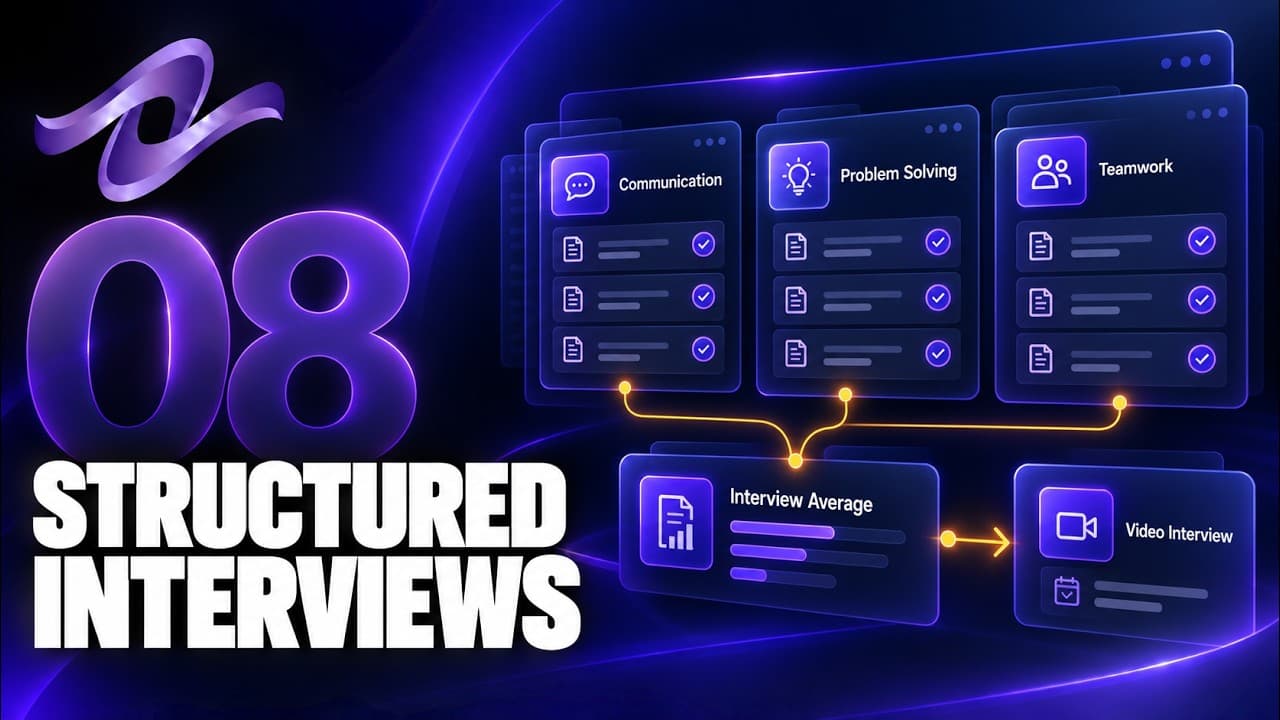
 Chapter 8
Hosted on YouTube. Nothing loads from YouTube until you press play.
Essentials · Chapter 8 · 8 of 24 in the series
Structured Panel Interviews in Quelixa
Conduct a structured interview in Quelixa with one independent score sheet per panel member. This chapter follows the candidates who passed the written test into a video interview, then shows how the panel records marks, competency evidence and recommendations.
01Lesson notes
What you will learn#
- How the interview register and panel are set up
- Why each member marks independently before scores are combined
- How evidence and competency notes support a score
- How marks become one averaged interview result
Step by step#
Recruitment › Interview Registers › Draft
- The panel — Design Selection Panel; marks as numbers; 45 minutes per candidate.
- When and where — Friday 23 October, 09:30, on video.
- Marks — Out of 100, pass at 50 — from the post.
- Quick Actions — Seven candidates waiting; readiness five of five.
Recruitment › Interview Registers › Candidates called
- Quick Actions — Invitations sent; no sheet submitted yet.
- Panel session — Seven candidates, forty-five minutes each.
Recruitment › Interview Registers › Schedule
- Panel & schedule — A sheet per member; a slot per candidate.
Recruitment › Interview Registers › Video link
- Format & video link — One video room for the day, on the invitation.
Candidate portal › Tests & interviews
- Interview — Friday, half past nine, on video.
Candidate portal › Application
- The invitation — Time, place, add to calendar — and the slots.
- By video — The interview card, while it is still to come.
- Join the call — Opens in the browser; nothing to install.
Recruitment › My Marking Sheets
- Her sheet — One sheet, for this interview.
- To score — Open and waiting.
Recruitment › My Marking Sheets › Scoring desk
- Scoring desk — Every candidate on her sheet, one card each.
- Quick Actions — Submit only once every attending candidate is scored.
Recruitment › My Marking Sheets › Sofia Lindqvist
- Marks — Out of a hundred.
- Recommendation — From strongly recommend to strongly do not.
- In writing — Strengths, concerns, and an overall assessment.
Recruitment › My Marking Sheets › Saved
- Saved — Her scores are kept; the sheet is still open.
- Progress — One of seven scored.
Recruitment › My Marking Sheets › Ready to submit
- Submit Sheet — Unlocked: every attending candidate has a score.
- Progress — A hundred per cent.
Recruitment › My Marking Sheets › Submitted
- Quick Actions — Reopen is possible — and recorded.
- Scoring desk — Read-only now.
Recruitment › Interview Registers › All sheets in
- Panel & schedule — Every sheet submitted.
Recruitment › Interview Registers › Closed
- Panel & schedule — Three sheets in; one mark per candidate.
- Sofia — Eighty-eight — the average of three sheets.
- All seven — Each with one mark, all above fifty.
On an interview you sit on, open My Marking Sheets and rate one candidate with a line of evidence per competency. Save without submitting, then try to compare candidates and note what stays hidden until every sheet is in.
Transcript
Three people, seven interviews
Lina: Monday in Singapore. Seven candidates passed the paper, and the panel has three people on it.
Kenji Sato: Seven interviews in a day. How do we keep the fourth as fair as the first?
Elena Novak: Everyone marks alone, on their own sheet, before anybody says a word.
David: That sounds simple. It rarely happens.
Lina: Which is why the system makes it the only way to do it.
Lina: This is chapter eight. A panel of three interviews the seven, each member scores on a sheet of their own, and the sheets become one interview mark.
The panel, set up once
Lina: Elena opens the interview register — the same idea as the test register, with a panel attached.
Lina: The panel is the Design Selection Panel, marking in numbers, forty-five minutes per candidate.
Lina: Friday the twenty-third, at half past nine, on video from the Singapore studio.
Lina: Marked out of a hundred, with a pass at fifty.
David: And those marks came from the post again?
Lina: Again. The interview's weight and pass mark were published on the advert in chapter three.
Lina: This time James signed the procedure off before the call, so readiness is already five of five.
What makes an interview comparable
Lina: An interview is the easiest place in hiring to fool yourself, so three things are worth insisting on.
Lina: Everyone marks alone. Three sheets, filled in before the panel talks to each other.
David: Otherwise the first person to speak sets the tone for the rest.
Lina: Every time. Second, everyone marks against the same criteria, and those come from the post — not from whatever the room feels like asking that morning.
Lina: And third, in writing. Strengths, concerns, a recommendation, for every candidate. Not just for the ones you argue about.
Called
Lina: She fetches the seven and locks the register. The invitations go out at once.
Lina: And the register now says what it is waiting for: none of three marking sheets submitted.
Seven slots, three sheets
Lina: Underneath, the day itself.
Lina: Three marking sheets — Ines, Mei and Kenji — one per panel member, each at nothing so far. And seven slots, forty-five minutes apart, starting with Sofia at half past nine.
David: One sheet each, not one sheet for the panel.
Lina: One each. That is the whole design: three people, three independent sheets.
A room, generated
Lina: It is a video interview, so Elena generates a room. The link goes onto every invitation.
Sofia's invitation
Lina: On Sofia's side, her tests and interviews page now has one more line: the interview, on Friday at half past nine, on video.
David: And the link to join?
Lina: On her application page — here is that page on Friday morning.
The link, where she needs it
Lina: At the top, her invitation: the time, the video room, and a link to add it to her calendar.
Lina: Further down, the interview card — and the button she needs.
Lina: Join the call. It opens in her browser, with nothing to install.
David: And after the interview?
Lina: The card goes. It is only there while the interview is still to come.
Mei's sheets
Lina: Friday, just after Sofia's slot. This is Mei's screen.
Lina: As a panel member she sees her own marking sheets — and the candidates only through them.
David: Not the other panel members' marks?
Lina: Not until all three are in. Otherwise the first sheet would quietly set the bar for the others.
The scoring desk
Lina: Her sheet opens as a scoring desk: one card per candidate, in the order of the day.
Lina: And the submit button stays locked until every candidate who attended has a score.
David: In the order of the day — so Sofia first.
Lina: Sofia first, at half past nine, and the rest in their slots.
Marking one candidate
Lina: Mei marks Sofia. Ninety, out of a hundred.
Lina: A recommendation, from strongly recommend down to strongly do not. She strongly recommends.
Lina: Each competency gets a rating, and a line of evidence: what did the candidate actually say or do? Technical knowledge, outstanding: she took a real checkout problem apart in ten minutes.
David: Evidence, not adjectives.
Lina: Evidence. And then in her own words: the strengths, the concern, and an overall view.
Saved, not submitted
Lina: She saves as she goes. Saved is not submitted — she can still change anything until she hands the sheet in.
Lina: One of seven, and the day has six more interviews in it.
David: Six more today. Does she have to mark them all at once?
Lina: Right after each slot is best, while it is fresh. The sheet waits for her either way.
Seven of seven
Lina: Three in the afternoon, and every card is scored.
Lina: The submit button unlocks.
David: And if one candidate had not turned up?
Lina: She unticks attended for that one, and the sheet can still be submitted.
Submitted
Lina: And submitted. The desk becomes read-only.
David: What if she wants to change a mark tomorrow?
Lina: She can reopen it, and the reopening is recorded. Changing a mark after the fact is possible; doing it quietly is not.
Three of three
Lina: Back on Elena's register at four o'clock: three of three sheets submitted.
Lina: Now — and only now — the marks can be combined.
David: And if one member never submits?
Lina: Then the register waits, and shows whose sheet it is still waiting for.
One mark per candidate
Lina: She closes the interview, and each candidate gets one mark: the average of three independent sheets.
Lina: Sofia, eighty-eight.
Lina: Emma, eighty-six. Claire, seventy-eight — and all seven above the pass mark.
David: Did the three sheets agree?
Lina: Closely, not exactly — which is what three honest sheets look like. The average evens out one person's good or bad morning.
Chapter eight, in five lines
Lina: Five lines.
Lina: The panel is set up once, with the pass mark from the post.
Lina: One sheet per member, and nobody sees another's marks until all three are in.
Lina: Marks come with evidence: what the candidate actually said or did.
David: And changing your mind later?
Lina: Possible, and recorded.
Lina: And the interview mark is the average of three independent sheets.
Two marks each
Lina: Friday evening. Every one of the seven now has two marks: the paper, and the panel.
Mei Tan: So who is first?
Elena Novak: The merit list decides that — by the weights on the advert, not by who we liked most.
Lina: That is the last chapter.
Lina: Next time the two marks become a merit list, the chair releases it, the offer goes out by rank, and the person who applied on a Tuesday evening in October becomes an employee.
David: See you in chapter nine.