
 Chapter 4
Hosted on YouTube. Nothing loads from YouTube until you press play.
Practitioner · Chapter 4 · 13 of 24 in the series
Use the Personality Index in Quelixa
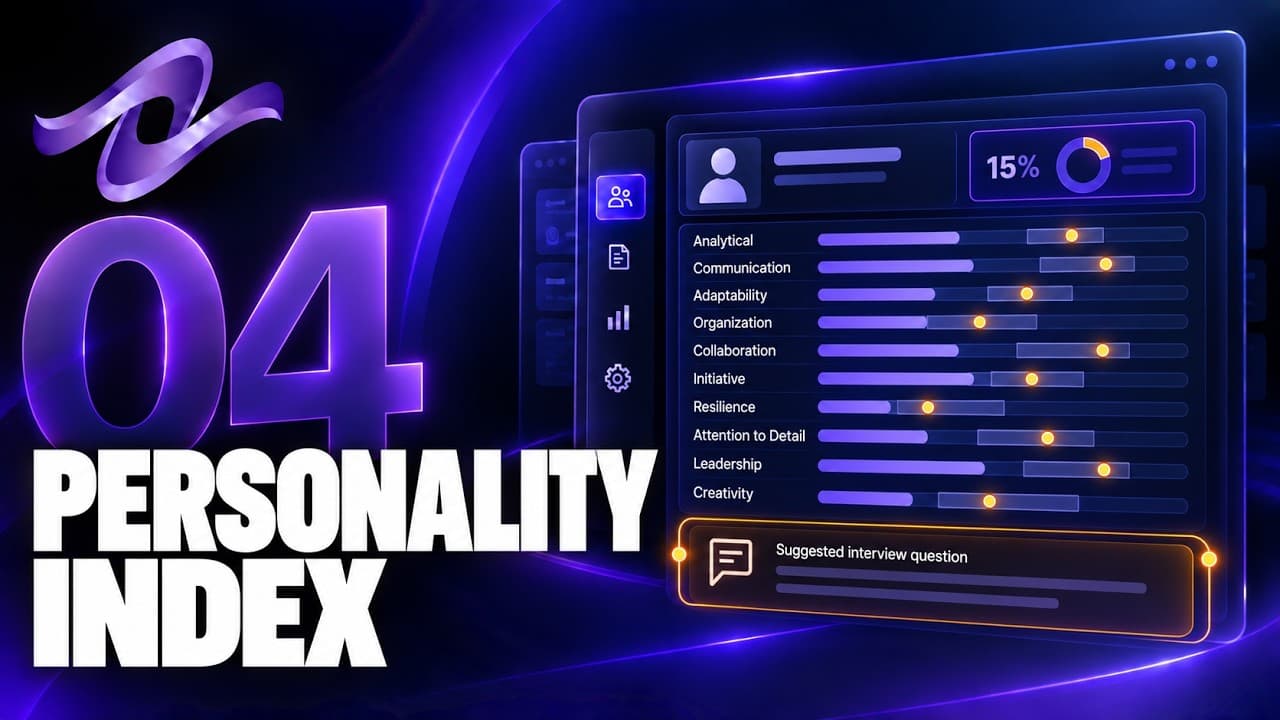
Explore the WorkStyle questionnaire in the Northwind Group hiring example: 100 statements across 10 traits, with role-specific target ranges. The example weights the test at 30%, interview at 55% and profile at 15%.
01Lesson notes
Step by step#
Recruitment › Personality Traits
- Team leadership — From contributes to takes the lead.
- Job continuity — From seeks variety to stays the course.
- Statements — Ten for each trait.
Recruitment › Online Test Papers › Personality Index
- A different kind of paper — No right answers.
- Statements per trait — Ten of each.
- How it is used — It counts only where a job gives it a weight.
- What candidates read — Answer as you usually are.
Recruitment › Job Posts › Customer Success Team Lead
- The questionnaire — Personality Index — work style.
- When it goes out — On passing scrutiny; five days to answer.
- Its weight — Fifteen per cent of the merit score.
- The target profile — Five traits, each with a range.
Recruitment › Job Posts › Target profile
- Team leadership — 60 to 100 — key to the role.
- Empathy — 55 to 100 — key.
- Collaboration — 45 to 90 — helpful.
Recruitment › Job Posts › Selection rules
- Test and interview — 30% and 55%.
- Total — 100 — with the profile's 15%.
- The minimum — Four years, a bachelor's degree.
Recruitment › Job Posts › Bonus marks
- Experience above the minimum — One mark a year, up to four.
- Desirable skills — Two marks each for Arabic and French, up to four.
Candidate portal › Application › How you are assessed
- How you are assessed — A hundred statements; the match counts 15%.
- The invitation — In her updates, with five days to answer.
Email › Layla Haddad
- A short questionnaire — For the team lead post.
- Open the questionnaire — Straight to it.
Candidate portal › Personality Index
- What it is — A hundred statements, thirty minutes, the closing date.
- No right answers — Answer as you usually are.
- Ready — On her own, as she usually is.
Candidate portal › Personality Index › Statement
- Statement 1 of 100 — How far do you agree?
- Five answers — From strongly disagree to strongly agree.
- Saved as she goes — Four answered.
Recruitment › Applications
- The team lead applicants — Blind at scrutiny.
Recruitment › Applications › Personality
- Profile match — 100% of five target ranges — counts 15%.
- Consistency — 75 — consistent.
- Completed — 16 minutes, 9.5 seconds a statement.
- Against the targets — Each trait on its bar, the target shaded.
Recruitment › Applications › Personality
- Match 94% — not counted — Flagged answers do not count.
- Consistency 32 — Inconsistent.
- Under two seconds a statement — Answered very quickly.
- Below the range — Leadership and steadiness.
Recruitment › Applications › For the interview
- Outside the range — Each gap comes with an interview question.
- Team leadership — "Tell us about a time you took charge without a title."
On a job post, open the selection rules and check that the weights add up to 100 with the profile's weight. Read the target profile and decide which two traits would be key for a role you hire for.
Transcript
How someone works
Lina: Tuesday the second of February. The Dubai hub needs one more person: a team lead for the four specialists.
Amara Okafor: Skills we can test. What I need to know is how they lead people under pressure.
James Whitfield: Then we ask it properly — the same questions for everyone, and we tell them how much it counts.
Lina: That is this chapter: the Personality Index — a work-style questionnaire, what it measures, and how much weight it should carry.
Lina: A work-style questionnaire has no right answers. It describes how someone says they work, and compares that with what the role needs — as one input, never the decision.
A profile, not a score
Lina: Four ideas.
Lina: One hundred short statements — agree or disagree — ten for each of ten traits.
Lina: The result is a profile: each trait lands somewhere between zero and a hundred. Nobody passes or fails.
David: So what makes a result good?
Lina: Only the role. Each job post says which range fits it, and how much each trait matters.
Lina: And the company chooses the weight. At zero per cent, the profile only helps the panel prepare the interview.
Ten traits
Lina: These are the ten traits.
Lina: Each one runs between two ends that are both fine: team leadership goes from contributes to takes the lead.
Lina: Job continuity from seeks variety to stays the course.
David: Neither end is the wrong one.
Lina: Neither. It depends on the job. And each trait has ten statements behind it.
The questionnaire
Lina: The questionnaire itself is an online paper of a different kind: no right answers.
David: Why ten for each?
Lina: Because one statement can be misread. Ten for each trait,
Lina: and the note on the right is the rule: it counts in the merit score only where a job post gives it a weight — and then as the match to that job's target profile.
Lina: Candidates are told to answer as they usually are, not as they think they should be.
Switched on for one post
David: Is it switched on for every job?
Lina: Only where someone chooses. On the team lead post, Elena switches it on.
Lina: The questionnaire,
Lina: sent automatically when an application passes scrutiny, with five days to answer,
Lina: and a weight of fifteen per cent.
David: Why fifteen and not thirty?
Lina: Enough to matter, not enough to outvote the interview.
Lina: Below that, the target profile for this role.
What this role needs
Lina: Team leadership from sixty up — key to the role: this person leads four specialists from day one.
Lina: Empathy, key as well.
David: And the other five traits?
Lina: Still measured, still shown to the panel — just not part of the match.
David: Why stop collaboration at ninety?
Lina: Because a lead who takes every decision to the group is not what Amara asked for. A range is what fits; more is not always better.
Where fifteen per cent comes from
Lina: The weights have to add up. Test thirty, interview fifty-five,
Lina: and with the profile's fifteen, a hundred.
David: So the merit score still reads as a percentage.
Lina: The minimums are the usual ones: four years' experience, a bachelor's degree.
Bonus marks
Lina: And on top of the weights, bonus marks, each with a cap.
Lina: One mark for each year beyond the four required, up to four marks.
Lina: Two marks each for Arabic and French — useful in Dubai, not required.
David: So the extras can't outweigh the assessment.
Lina: Capped, and published with the post.
Four rules worth keeping
Lina: A few rules make this fair.
Lina: Candidates are told before they answer — what it is and how much it counts.
Lina: The target is a range that fits the role, set before anyone applies.
David: And it never decides on its own.
Lina: Never. And if a company is not comfortable with it counting at all, zero per cent is a perfectly good setting.
Said up front
Lina: Monday the eighth: Layla passed scrutiny this morning. Her application page says exactly what comes next.
Lina: A hundred statements, no right or wrong answers, and the match to this role counts fifteen per cent.
David: Before she's answered a single one.
Lina: The invitation is in her updates: complete it within five days.
Fifteen minutes
Layla Haddad: One hundred statements, no right answers. Fine — let's be honest about it.
Lina: Half past seven in Dubai. Layla opens the questionnaire.
The invitation
Lina: The email that came at five past ten.
Lina: How many statements, about how long, the date to finish by — and one button.
Before she starts
Lina: A hundred statements, thirty minutes, and the closing date.
Lina: The line that matters most: there are no right or wrong answers.
Lina: She ticks that she will answer on her own, as she usually is.
One statement at a time
Lina: One statement at a time: how far do you agree?
Lina: Five answers, from strongly disagree to strongly agree.
David: Some of them are written the other way round?
Lina: Half of them — agreeing with this one means less drive, not more. It keeps people from agreeing with everything.
David: And if her connection drops?
Lina: Every answer is saved the moment she gives it.
Handing it in
Lina: Sixteen minutes later: a hundred of a hundred, and she hands it in.
Her answers, in her own words
Lina: And straight away she sees her own profile — in words, trait by trait.
David: She gets to see it before the panel does?
Lina: She sees what she said about herself. Not the target, not the score — those stay with the panel.
Four profiles
Elena Novak: All four have answered. One of them in three minutes.
James Whitfield: Three minutes for a hundred statements? Let's see what that looks like.
Lina: Wednesday morning. Elena opens the applications — still blind at scrutiny.
Four applicants, four codes
Lina: Four applicants for the team lead post, under codes.
David: Still no names at this stage.
Lina: Not until scrutiny is over — the profile is read blind too.
One profile
Lina: One of them — Layla, though Elena only sees a code.
Lina: Profile match: a hundred per cent. Every trait inside its target range.
Lina: Each bar is a trait, the shaded band is the range the post asked for, and the dot is where her answers put her.
David: How does it know the answers are real?
Lina: Two checks. Consistency: statements about the same trait were answered the same way — seventy-five.
Lina: And pace: sixteen minutes, about nine seconds a statement.
The three-minute one
Lina: And the three-minute one.
Lina: One point eight seconds a statement — flagged,
Lina: and a consistency of thirty-two: the same trait answered one way, then the other.
David: But the match is still ninety-four per cent.
Lina: Because random answers land in the middle, and the middle sits inside most ranges. That is exactly why flagged answers do not count: the note says this match adds nothing to the merit score.
Lina: Two traits even fall below the range the post asked for.
David: Is he out, then?
Lina: No. The questionnaire doesn't reject anyone. It simply stops counting, and the panel finds out more.
Questions for the panel
Lina: What the profile is best at is this: for every trait outside the range, a question for the interview.
Lina: Team leadership: tell us about a time you had to take charge of a group without a formal title.
David: So the panel asks, instead of assuming.
Lina: Exactly. The questionnaire opens a conversation; the interview settles it.
Three things to keep
Lina: Three things to keep.
Lina: It is a profile against ranges that fit this role — not a verdict on a person.
Lina: Answers are checked before they count, and rushed or inconsistent ones earn nothing.
David: And the people in the room still decide.
Lina: Every gap becomes a question for them.
The questions themselves
Amara Okafor: Those interview questions are good. Can every candidate get the same ones?
Elena Novak: That's what an interview kit is for.
Lina: Next chapter: structured interview kits — the same questions, anchored ratings, and a panel that marks apart.
Lina: That was the Personality Index. See you in chapter five.