
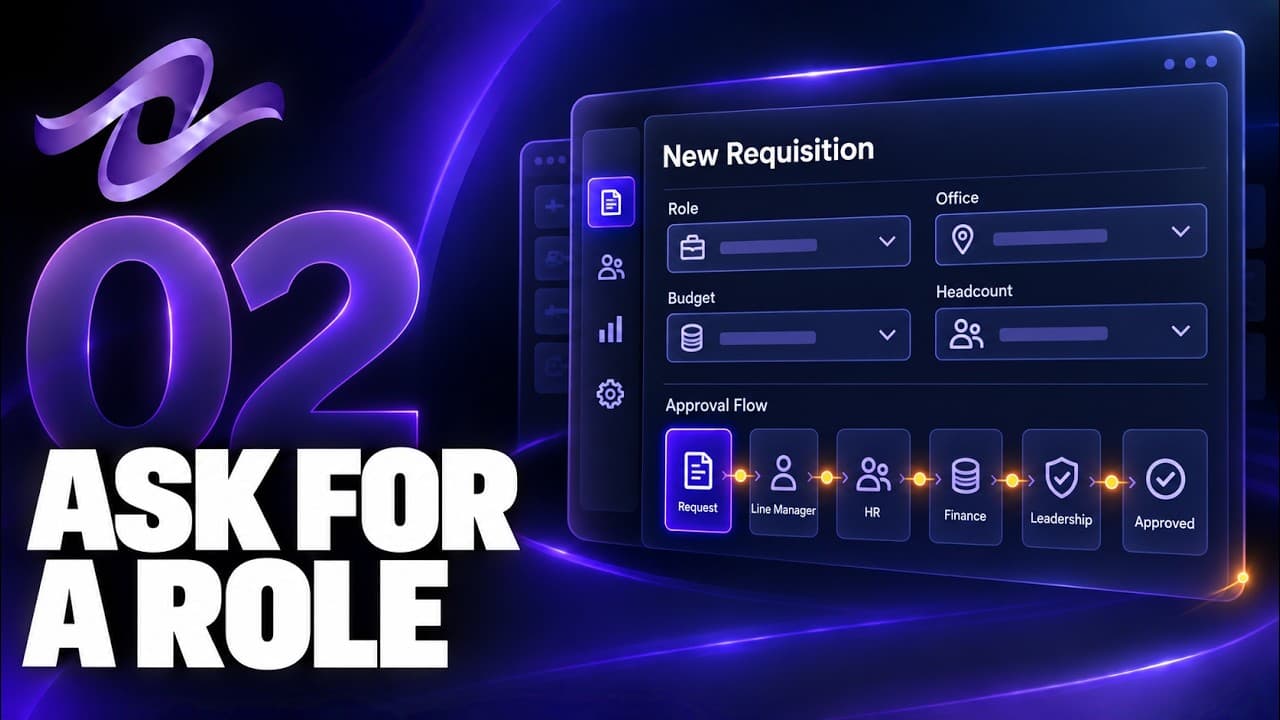
 Chapter 2
Hosted on YouTube. Nothing loads from YouTube until you press play.
Essentials · Chapter 2 · 2 of 24 in the series
Raise a Recruitment Requisition in Quelixa
Every hire begins with a clear request. Learn how a hiring manager raises a requisition in Quelixa with the role, business reason, office, headcount, cost and planned start date, then follows its approval ladder.
01Lesson notes
What you will learn#
- What belongs on a hiring requisition and why
- How a visible approval ladder works
- Why the requester does not approve their own request
- How an approved request reserves a seat and leads to a job post
Step by step#
Recruitment › My Requisitions › RQ/2026/0031
- The ladder, up front — Every seat the requisition must pass, shown before it is submitted.
- What is being hired — Job, department, office and the head who will see it first.
- Completeness — The form scores itself; you know what is missing before anyone else does.
- One action at a time — In draft there are exactly two things you can do.
Recruitment › My Requisitions › The case
- Job purpose — Why the role exists, in the requester's own words.
- Key functions — What the person will actually own once they arrive.
- What it takes — Knowledge, skills and abilities — and later, the eligibility rules.
Recruitment › My Requisitions › Submit for approval
- It tells you who is next — The first seat is named before you commit, not after.
- Still reversible — Nothing has moved until Submit is pressed.
Recruitment › Requisitions › Dept. Head
- Approve — Agree, and it moves to the next seat.
- Refuse — Stop it here, with a reason on the record.
- Send back for changes — Return it to the requester without killing it.
Recruitment › Requisitions › Approve
- A comment goes with it — Optional, and almost always worth writing.
- Then it is committed — The approval is stamped with who, when and on what grounds.
Recruitment › Requisitions › Approved
- The ladder is complete — Every seat, with who signed and when.
- Seats are reserved — The establishment now holds one post for this requisition.
- It can be advertised — Only an approved requisition can become a job post.
Recruitment › Requisitions
- The quarter in five numbers — Drafts, in review, approved, and seats filled against seats approved.
- Where each one has reached — The stage column names the seat it is sitting on right now.
- What came of it — Applications and hires, counted back against the requisition that started them.
In Recruitment › My Requisitions, start a draft requisition for a role your team needs. Watch the completeness score as you fill in the job purpose and key functions, read the approval ladder shown above the form, then cancel the draft.
Transcript
The role nobody asked for
Lina: Every hire in this course starts the same way: somebody notices the work is bigger than the team.
Mei Tan: We have shipped three releases now with a designer borrowed from engineering.
Kenji Sato: And every release, something waits.
David: Borrowing someone for three releases running is not borrowing any more.
Lina: That is Mei Tan, who runs product in Singapore, and Kenji Sato, her director. They have wanted a designer for months. What they have never done is ask for one properly.
David: What does asking properly even mean?
Lina: It means a requisition: one record that says what the role is, why it is needed now, what it costs, and who agreed to it.
Lina: This is chapter two. We are going to raise that requisition, walk it up the approval ladder, and watch it turn into something a candidate can apply to.
What a requisition has to answer
Lina: A requisition is four questions, and the form is built around them.
Lina: What the role is — the job, the department, the office and the number of seats.
Lina: Why it is needed now. New position, replacement, expansion, project. It sounds like paperwork; it is the thing the approver actually weighs.
David: And the money?
Lina: On the requisition, not in a side conversation. The approver sees the figure they are agreeing to.
Lina: And when it should start, because every date after this one is counted backwards from it.
Mei writes the ask
Lina: This is Mei's requisition, still in draft. Nobody outside her team has seen it.
Lina: The strip across the top is the whole approval ladder, and it is there before she submits — she can see every seat this will pass through.
David: So no surprises about who has to say yes.
Lina: None. Underneath, what is being hired: the job, the department, the office, and the department head it will land on first.
Lina: On the right, the form scores itself. A hundred per cent means nothing required is missing.
Lina: And the actions stay honest. In draft there are two: submit it, or cancel it.
The part that persuades
Lina: Scroll down and you reach the part that does the persuading.
Lina: Job purpose is where Mei says why the role exists at all. Three sentences, in her words, not a template.
Lina: Key functions is what the person will own from day one.
David: Does any of this get reused later?
Lina: All of it. What you write here becomes the advert, and the skills become the rules that decide who is eligible. Write it once.
Submitting, in the open
Lina: When she submits, the system does something quietly decent.
Lina: It tells her exactly who gets it first, by name, before she commits to anything.
David: That is a small thing that saves a lot of chasing.
Lina: It does. And until she presses submit, nothing has moved.
The ladder a requisition climbs
Lina: Here is the whole ladder on one line. Six stops, and the requisition is on exactly one of them at any moment.
Lina: Draft belongs to the requester. Nobody else is looking.
Lina: Submitted, and it leaves her hands.
Lina: The department head decides whether the team really needs it.
David: And the HR step — what is that for?
Lina: Grade and band. HR checks the role sits where the salary says it sits, against the scale for that office.
David: And if somebody says no halfway up?
Lina: It stops there, with the reason on the record, and everyone below can see where it stopped.
Lina: Otherwise it reaches the authority, who holds the budget.
Lina: Approved, and the seats are reserved against the establishment. Only then can anyone advertise it.
Three real choices
Lina: Now it is Kenji's. And notice what he is offered.
Lina: Approve, and it moves up.
Lina: Refuse, which stops it here with a reason attached.
David: And if it is nearly right but not quite?
Lina: Send it back for changes. The requisition returns to Mei, still alive, with what needs fixing. That third option is the one that keeps people using the system instead of going around it.
Lina: And one rule sits underneath all three: whoever submitted the requisition cannot be the one who approves it. Not by convention — the seat simply will not accept them.
Saying why, not just yes
Lina: Approving opens a comment box.
David: Does anybody actually fill those in?
Lina: It is optional. It is also the difference between a record that explains itself in a year and one that does not.
Lina: Kenji writes why, and confirms. The approval is stamped with his name, the time, and what he said.
What approval unlocks
Lina: HR checks the band, the authority signs, and the ladder is done.
Lina: Every seat on that strip now carries a name and a time.
Lina: The seat is reserved against the establishment — the company is holding a post open for this role.
David: And this is the point where it becomes real to the outside world?
Lina: This is the point. An approved requisition is the only thing that can become a job post, which is where chapter three starts.
Three things you get for free
Lina: Three things fall out of doing it this way.
Lina: Nothing jumps the queue. The same seats, the same order, whichever office raised it.
Lina: The reasoning survives. Six months later you can see not just that it was approved, but why.
David: That is usually the bit that has evaporated by the time anyone asks.
David: And the budget?
Lina: Reserved the moment it is approved. Two teams cannot quietly spend the same post.
Every ask, one list
Lina: And this is the view an HR team lives in: every requisition in the cycle, whichever office raised it.
Lina: The top row is the quarter in five numbers — including how many seats you have actually filled against how many were approved.
Lina: The stage column tells you where each one has got to, and which seat it is waiting on.
David: So I can see what is stuck without opening anything.
Lina: Exactly that. And on the right, what came of each one — who applied, who was hired, counted back against the ask that started it.
Chapter two, in five lines
Lina: So, five lines.
Lina: A requisition is the ask: what, why, what it costs, when it starts.
Lina: It scores its own completeness, so you find the gaps before an approver does.
Lina: The ladder is visible before you submit, not discovered afterwards.
David: And an approver is never stuck choosing between yes and no.
Lina: Never. Approve, refuse, or send it back — that third one is what keeps the process honest.
Lina: And approval reserves the seat, which is what lets the role be advertised at all.
One ask, four signatures
Lina: Two days after Mei raised it, the answer came back.
Mei Tan: Approved. And I can see who signed it and what each of them said.
Kenji Sato: Which is more than I could tell you about the last one.
Lina: Next, the role has to leave the building.
Lina: In chapter three we put the role out — to the careers page, to the job boards, and to the people already working here.
David: See you there.