
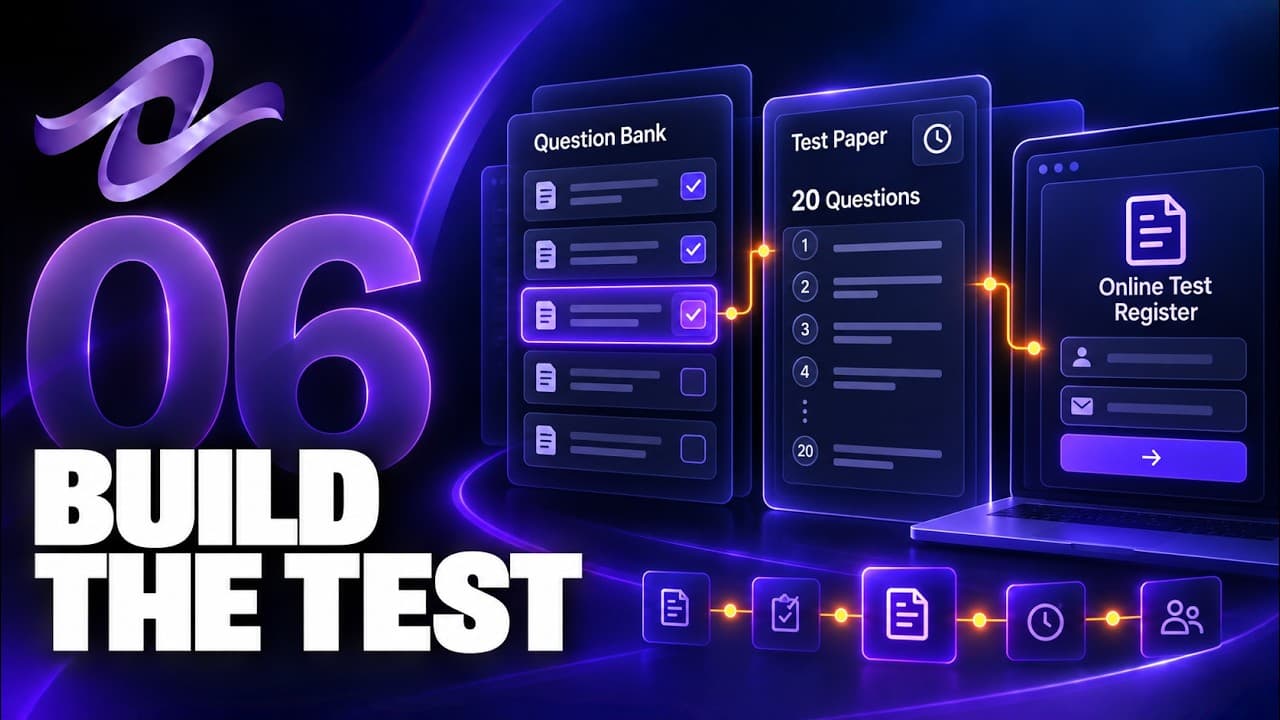
 Chapter 6
Hosted on YouTube. Nothing loads from YouTube until you press play.
Essentials · Chapter 6 · 6 of 24 in the series
Build an Online Recruitment Test in Quelixa
Build a recruitment assessment from reviewed questions to an online sitting. This lesson shows the question bank, a 20-question timed paper and the test register that calls candidates who have passed scrutiny.
01Lesson notes
What you will learn#
- The distinction between question bank, paper and sitting register
- Why draft questions need review before use
- How a timed online paper and its window are configured
- How candidates are fetched from scrutiny and notified
Step by step#
Recruitment › Assessment Topics
- Product design — The topic this paper draws on.
- Questions — How many live questions each topic holds.
Recruitment › Question Bank
- Drafts — Waiting for review — not usable in a paper.
- Drawable — Reviewed and valid: these can go on a paper.
- Mei's question — Entered this morning, still a draft.
Recruitment › Question Bank › Draft
- Reviewed — may be drawn — Off: nobody has checked it yet.
- Options — Four answers, one marked correct.
- Mark as Reviewed — The second pair of eyes.
Recruitment › Question Bank › Reviewed
- Reviewed — may be drawn — Now on: it can be used in a paper.
Recruitment › Online Test Papers › Product design exercise
- Fixed questions — Every candidate gets these, on top of any random draws.
- Composition — What a candidate will actually receive.
Recruitment › Online Test Papers › Settings
- Time allowed — Thirty minutes, running from the moment she starts.
- Shuffling — Questions and options in a different order for each candidate.
- Tab switches — Three are allowed; a fourth raises a flag.
- Results — Released with the test result, not on the spot.
Recruitment › Online Test Papers › Twenty questions
- Random draws — Each candidate gets a different set from the bank, per topic.
- Fixed questions — Everyone gets the same twenty.
- Composition — Ready: twenty questions in thirty minutes.
Recruitment › Test Registers › Draft
- The sitting — The date, the venue — online — the duration and the invigilator.
- Online delivery — The paper, and the window it is open.
- Quick Actions — Eight scrutinised candidates, waiting to be fetched.
Recruitment › Test Registers › Score sheet
- Score sheet — One row per candidate, fetched from scrutiny.
Recruitment › Test Registers › ISO 10667
- Assessment procedure — What is measured, how it is scored, who validated it.
- Validated by — Empty for now.
Recruitment › Test Registers › Ready to call
- Quick Actions — Readiness against the standard, and the next step.
- Lock & Call Candidates — Freeze the list and send the call letters.
Recruitment › Test Registers › Candidates called
- Score sheet — Eight candidates, by name now, marks still to come.
Recruitment › Test Registers › Validated
- Assessment procedure — Now complete.
- Validated by — James Whitfield, recruitment manager.
Candidate portal › Dashboard
- Upcoming sittings — The test, the date and how it is delivered.
- Latest updates — Called for the test; the online test is ready.
Candidate portal › Online tests
- The paper — Twenty questions, thirty minutes, and the window — opens soon.
In Recruitment › Question Bank, add a draft question for a role you hire for, with four options and one marked correct. Ask a colleague to mark it reviewed, then confirm it now counts as drawable.
Transcript
What will it actually ask?
Lina: Monday in Singapore. Eight people are through scrutiny, and the next step is a written test that does not exist yet.
Mei Tan: I sent you my questions last week. And one more at midnight.
Elena Novak: Then let us turn them into a paper everyone can sit, from wherever they are.
David: From five countries, on the same day?
Lina: From eight countries, in one twelve-hour window. This chapter builds it: the questions, the paper, and the sitting.
Lina: This is chapter six. We build a written test from nothing — a bank of reviewed questions, a timed paper, and a register that calls the candidates.
A test is built in four layers
Lina: A test in Quelixa is four layers, and each one is reused differently.
Lina: The question bank holds questions, each with its answer key, and each reviewed before it can be used.
Lina: A paper picks questions from the bank and sets the rules: how long, in what order, what happens if you leave the window.
David: And the register is the day itself?
Lina: The register is one sitting: this post, this date, these candidates.
Lina: And the call is what the candidates receive. Build the first two once, and every future sitting reuses them.
The bank, in topics
Lina: The bank is organised by topic. General aptitude, numerical reasoning, verbal reasoning — and product design, which is ours.
David: So a topic is just a shelf.
Lina: A shelf, and the count beside it is how much it holds today.
Drawable, or not yet
Lina: And this is the bank itself. The top row is the question the whole screen answers: what can I use?
Lina: Thirty-six questions are drawable — reviewed, valid, ready.
Lina: One is a draft. It is Mei's question from last night, which Elena entered this morning.
David: Why can't she just use it?
Lina: Because nobody has checked it yet. A draft never reaches a candidate.
Mei's question
Lina: Here it is. A new market reads right to left — what do you check first?
Lina: Four answers, and one ticked as correct. The wrong ones are the kind a hurried designer might pick, which is what makes it a real question.
Lina: And the flag that matters: reviewed. It is off.
David: Who turns it on?
Lina: Somebody who did not write it. That is the whole review, and the button for it is right there.
Three tests for every question
Lina: Three tests every question has to pass before it belongs in a paper.
Lina: It tests the job. Not general knowledge — something the person would face in their first month.
Lina: One answer is defensible, and the others are plausible. A question with a silly wrong answer is really a question with three options.
Lina: And someone other than the author has checked it. The system enforces that last one for you.
David: Which of the three do teams skip?
Lina: The third, usually. Checking a colleague's questions feels awkward — which is exactly why the system insists on it.
In the bank
Lina: Elena reads it, agrees, and marks it reviewed.
Lina: The status changes from draft to in the bank.
David: Only for this paper?
Lina: For any paper, for any post that tests product design. Written once, reviewed once, reused.
The paper, one short
Lina: Now the paper. It already holds nineteen questions, every one reviewed.
Lina: And the composition at the bottom says what a candidate will actually receive: nineteen questions, in thirty minutes.
David: Nineteen is an odd number for a paper out of a hundred.
Lina: It is. Twenty makes every question worth five per cent — and Mei's question is the twentieth.
The rules of the paper
Lina: The top of the paper holds its rules.
David: Thirty minutes from when?
Lina: From the moment a candidate starts, not from when the window opens.
Lina: Questions and options shuffled, so two candidates never see the same order.
David: Because they are sitting at home.
Lina: Because they are sitting at home. For the same reason, leaving the test window is recorded — three times is allowed, and a fourth raises a flag for the recruiter.
Lina: And the score is not shown the moment she hands in. It comes with the result, once the register closes.
Fixed, or drawn
David: And Mei's question goes on.
Lina: As question twenty.
Lina: There are two ways to build one. Random draws give every candidate a different set from the bank — useful when hundreds sit a test over weeks.
Lina: Fixed questions give everyone the same twenty.
David: And for eight people on one day?
Lina: Fixed is the fairer choice. Nobody can say their questions were harder.
Lina: And the composition turns green: twenty questions, thirty minutes, ready to attach to a sitting.
One sitting
Lina: That afternoon Elena opens the register — the record of this one sitting.
Lina: Friday the sixteenth, online, thirty minutes, with an invigilator named. And look at the total marks and the pass mark.
David: She did not type those.
Lina: She did not. They come from the post — set in chapter three, before anyone applied.
Lina: Underneath, the paper we just finished, and a window from nine in the morning to nine at night, in UTC. Twelve hours, so everyone can sit it in daylight.
David: And it already knows who is waiting.
Lina: Eight candidates, straight from scrutiny.
Eight rows, still codes
Lina: Fetch the candidates, and the score sheet fills: one row each.
David: Still under codes.
Lina: Still under codes. They are not called yet — until they are, blind review holds.
How the test is run, written down
Lina: Further down, the procedure — under ISO 10667, the international standard for delivering an assessment.
Lina: What is measured, how it is scored, and that feedback goes to candidates.
Lina: And one field still empty: who validated the procedure.
David: Is that page for an auditor, or for the candidates?
Lina: Both. Candidates read it on their own portal, and it stays on the record for anyone checking later.
Four of five
Lina: Tuesday morning, and the register grades itself: four of five. The missing one is that validation.
David: Does that stop her from calling them?
Lina: It does not. A standard is not a gate. But the flag stays until somebody accountable signs.
David: So she calls them anyway.
Lina: She locks the register, and the call letters go out.
The call brings the names back
Lina: This is where chapter five left them.
Lina: And the moment they are called for the test, the names come back.
David: Why give them back at all?
Lina: Because from here on, people have to meet them. You cannot interview a code.
Called, by name
Lina: The same eight rows — by name now.
David: And they have all been told?
Lina: Every one of them has a call letter and an online invitation, sent the moment she locked it.
Signed off
Lina: By mid-morning James, the recruitment manager, has read the procedure and signed it.
Lina: Five of five. And if anyone asks in a year how this test was run, the answer is on this page, with a name against it.
David: Could Elena have signed it herself?
Lina: She built the test, so it should be someone accountable for how it is run. Here, the recruitment manager.
What Sofia sees
Lina: And on Sofia's side, that evening, the portal has moved.
Lina: Her next step is the written test, on Friday, online.
Lina: And her updates say why: called for the written test, and the online test is ready.
David: Four days' notice.
Lina: Four days, with the date and how she sits it on her own dashboard.
Opens soon
Lina: Her online tests page shows the paper: twenty questions, thirty minutes, and the window. The button says it opens soon.
David: So she knows exactly what she is walking into.
Lina: Exactly. Nobody is surprised by the length of a test on the morning.
Chapter six, in five lines
Lina: Five lines.
Lina: Questions live in a bank, each with an answer key, and a draft never reaches a candidate.
Lina: A paper sets the rules: time, order, the window, when results appear.
Lina: A register is one sitting, and its pass mark comes from the post.
David: And the standard?
Lina: Graded on the record, and signed by a person.
Lina: And the call is the moment the names come back.
Friday, nine o'clock
Lina: Thursday afternoon. Everything is ready, and there is nothing left to do but wait.
Mei Tan: What if someone's connection drops halfway through?
Elena Novak: Every answer is saved as they give it. They sign in again and carry on.
Lina: And tomorrow we watch them sit it. That is chapter seven.
Lina: Next time, eight people in eight countries sit the paper, and the register marks it.
David: See you in chapter seven.