
 Chapter 5
Hosted on YouTube. Nothing loads from YouTube until you press play.
Essentials · Chapter 5 · 5 of 24 in the series
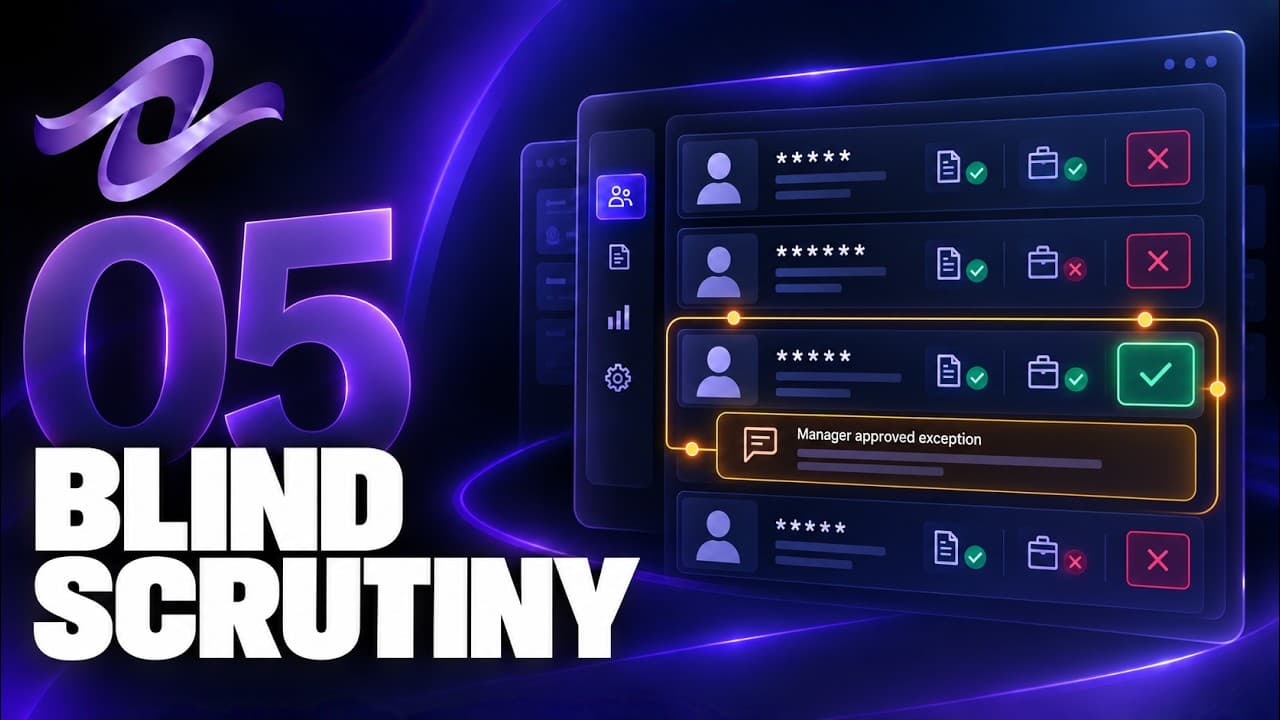
Blind Candidate Screening in Quelixa
How can a team check eligibility without deciding on a candidate's name or photograph? This chapter shows Quelixa's blind scrutiny view, where reviewers compare qualifications and experience with rules published on the job post.
01Lesson notes
What you will learn#
- What blind review hides and what job-related facts remain visible
- How published eligibility rules are applied to applicants
- How a waiver preserves the failed rule and the reason for an exception
- Why rejection reasons and review history matter
Step by step#
Recruitment › Applications › Board
- New — awaiting scrutiny — Everything that came in through the advert, in one column.
- Scrutiny — eligible on paper — Where they go once somebody has checked them against the rules.
Recruitment › Applications › Candidate C-FFCB4
- It says so plainly — The system tells the reviewer what is hidden and why.
- Where it stands — Seven steps, and which one it is on now.
- Skill match — Measured against the skills the post asked for.
Recruitment › Applications › Profile
- Education — Degree, institution and result — all of it readable.
- Experience — Every role, with dates, exactly as submitted.
- Documents — What she uploaded, ready to open.
Recruitment › Applications › Not eligible
- It quotes the rule — Not "rejected" — the specific rule, and the number against it.
- There is a way back — A waiver exists, and it needs a manager.
- Or an honest no — Reject, with a reason that goes to the candidate.
Recruitment › Applications › Eligibility override
- The justification — Why the rules should be waived, in writing, before anyone decides.
- What it failed on — The rule stays on the record; the waiver sits next to it.
Recruitment › Applications › Recruitment Manager
- Not the person who asked — The waiver goes to a manager, with the reasoning attached.
Recruitment › Applications › Waived
- Both are shown — The failed rule and the granted waiver, side by side.
- Back in the run — She rejoins the process at the same step as everyone else.
Recruitment › Applications › After scrutiny
- The column empties — Everything that arrived has been decided, one way or another.
- Eight carry on — Seven on the rules, one on an approved waiver.
On Recruitment › Applications › Board, open an application in scrutiny and read the panel that explains what is hidden under blind review. Find where a rule is quoted against a candidate's number, and where a waiver would be requested.
Transcript
Ten people said yes
Lina: A week after the advert went live, the studio has ten applications for one seat — Sofia's among them.
Mei Tan: Ten is more than I expected. How long does it take to read them?
Elena Novak: Reading them is not the hard part. Deciding fairly is.
David: And this is where most hiring processes quietly go wrong.
Lina: It is. Because the moment you can see who somebody is, you start deciding before you have read anything.
Lina: This is chapter five. The applications are in, the rules we set in chapter three do the first pass, and the people reviewing them cannot see a single name.
Ten arrive at once
Lina: Here is the board on Thursday morning.
Lina: Everything the advert brought in lands in one column, whichever channel it came through.
David: And already not a single name on any card.
Lina: Not one. What you can see is the role, the qualification, the years, and how long they have waited.
Lina: The next column is where they move once somebody has checked them against the rules.
What a reviewer is allowed to see
Lina: Three of the ten, as they exist in the system.
Lina: Turn blind review on, and the names go.
David: Everything else stays?
Lina: Everything the decision needs stays: the qualification, the years, the skills. What goes is the part that lets a reviewer decide before they have read anything — the name, the photo, the gender, the contact details, the family data.
Lina: A code is not a person. That is the entire point of it.
One application, under a code
Lina: Open one of them and the whole record is there — under a code.
Lina: And the system is explicit about it. It tells the reviewer exactly what is hidden, and until when.
David: I like that it says it out loud rather than just doing it.
Lina: So do I. A reviewer who knows the rules can trust them.
Lina: Underneath, the seven steps, and which one this application is sitting on.
Lina: And a skill match, counted against the skills the post actually asked for — not a hunch.
The resume, in full
Lina: And this is the part that surprises people the first time.
Lina: The education is all there. Degree, institution, result.
Lina: So is every role they have held, with the dates.
Lina: And the documents she uploaded on Tuesday night, ready to open.
David: That is a complete picture. So what is actually missing?
Lina: Only who they are. Everything a fair decision needs is on this page; the part that biases it is not.
Lina: I should be straight about one thing: the city and the age are shown, because the post can set rules about both. Blind review hides identity — it does not hide the facts the rules are made of.
Ten applied. Who is eligible?
Lina: Now the rules we wrote in chapter three do the first pass.
Lina: The qualification first. The post asked for a bachelors degree or above, and nine of the ten have one.
David: So one falls at the first gate.
Lina: One does. Then the years — four or more — and two more come out.
Lina: Seven eligible on paper, and not one of those decisions was a judgement call. They were the rules, applied.
Lina: Which is exactly why the rules go on the post before anybody applies.
When somebody falls short
Lina: Here is one who did not clear it.
Lina: And look at how it says so. Not a verdict — the rule, and the number measured against it.
David: Two years against a four-year minimum. Hard to argue with.
Lina: Hard to argue with, and easy to explain. Which matters when they ask.
Lina: There is a way back, though. A waiver — and it needs a manager, not the recruiter.
Lina: Or an honest no, with a reason that goes to the candidate rather than silence.
Asking for an exception
Lina: This one is different, and worth slowing down for.
Lina: Eight years of product design, and no degree. She fails a rule that two others fail — for an entirely different reason.
David: And a rule written for good reasons would lose her.
Lina: It would. So the recruiter asks for a waiver, and has to say why, in writing, before anyone considers it.
Lina: The justification is not a conversation. It is part of the record from the moment it is written.
Someone else decides
Lina: And the person who asks for the waiver is never the person who grants it.
Lina: It goes to a recruitment manager, with the reasoning quoted back to them, and two answers available: approve, or refuse.
David: Same shape as every other decision in this course.
Lina: Same shape exactly. Somebody with the authority, a reason on the record, and no way to do it quietly.
The exception, on the record
Lina: The waiver is granted, and here is the part I would put on a poster.
Lina: The failed rule does not disappear. It sits there, with the waiver next to it, and the reason underneath.
David: So in a year, anyone can see both the rule and why it was set aside.
Lina: Both. An exception that erases what it overrode is not an exception, it is a cover-up.
Lina: And she rejoins at the same step as everybody else. A waiver buys her a fair hearing, not a shortcut.
What scrutiny is not
David: Where do people usually get scrutiny wrong?
Lina: In three places.
Lina: It is not a shortlist. It asks one question: does this person meet the rules the post published?
Lina: It is not a judgement. Nobody is compared with anybody else — that comes later, and it comes on marks.
David: And it is not the last word.
Lina: It is not. A rejection carries a reason, the candidate is told, and they can appeal it from their own tracking page.
Where the ten ended up
Lina: By the end of the week, the first column is empty.
Lina: Everything that arrived has been decided — and decided in a way somebody could explain to the person it happened to.
Lina: Eight carry on. Seven because they met the rules, one because a manager waived one in writing.
David: And the two who did not?
Lina: Were told why, on the day, with the rule quoted. That is not a kindness — it is the least a process owes somebody who spent an evening applying.
Chapter five, in five lines
Lina: Five lines.
Lina: Applications land in one place, whichever channel brought them in.
Lina: Reviewers see a code, not a person — and the system says so plainly.
Lina: The rules do the first pass, and they were set before anyone applied.
David: And when the rules would lose somebody they shouldn't?
Lina: A manager waives them, in writing, and the waiver sits beside the rule it set aside.
Lina: And nobody is rejected into silence. There is a reason, and there is an appeal.
Eight still standing
Lina: Eight applications go forward, and Mei still does not know a single name.
Mei Tan: When do I find out who they are?
Elena Novak: The moment they leave scrutiny. Which is Monday.
David: Just in time to test them. With what, though?
Lina: With a paper somebody still has to build. That is chapter six.
Lina: Next time the names come back, and before anybody sits a test, we build one — the questions, the paper and the register.
David: See you in chapter six.